

01
Clutching
Small and large corrections to view and position “without thinking”. The most economical sequence. Four exercises.
Home / Simulators / RoboS
VirtaMed · Robotic surgery
The console of the leading robotic system — outside the operating theatre. And the only place where the surgeon and the bedside assistant can train together.
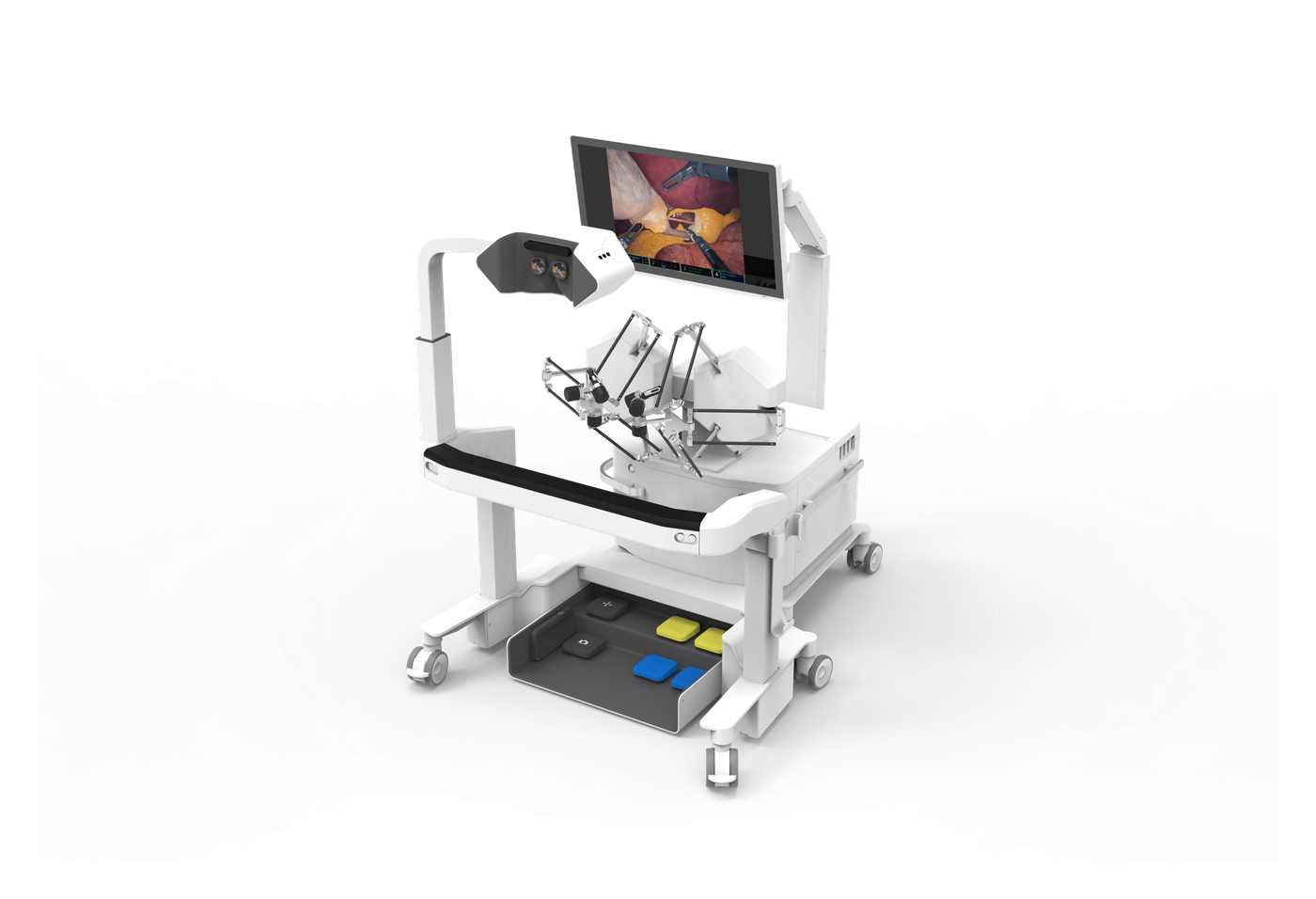
The training content, in full
The exercise count is taken from VirtaMed's module descriptions of 1 April 2026. Cholecystectomy is counted by scenario, not by exercise — so a scenario label appears there, not a number.
Foundational skills
22
Clutching, articulation, no-haptics,
needle work, fourth arm, energy
AVAILABLE
Advanced suturing
28
Knots, single and running sutures,
barbed suture, anastomosis
AVAILABLE
Cholecystectomy
—
Three scenarios: uncomplicated · acute
cholecystitis · high-BMI patient
AVAILABLE
Team training
8
Coordination, clipping, exposure,
traction and communication
AVAILABLE
THE SCORING
Feedback
Assistant
The metrics are what shape console behaviour: they reward desired actions and penalise undesired ones. Feedback does not end with a score — Feedback Assistant shows exactly where points were lost and why. The metrics are defined by an expert panel in robotic surgery, not by a marketing department.
58
EXERCISES
4
PANEL EXPERTS
What the console alone cannot do
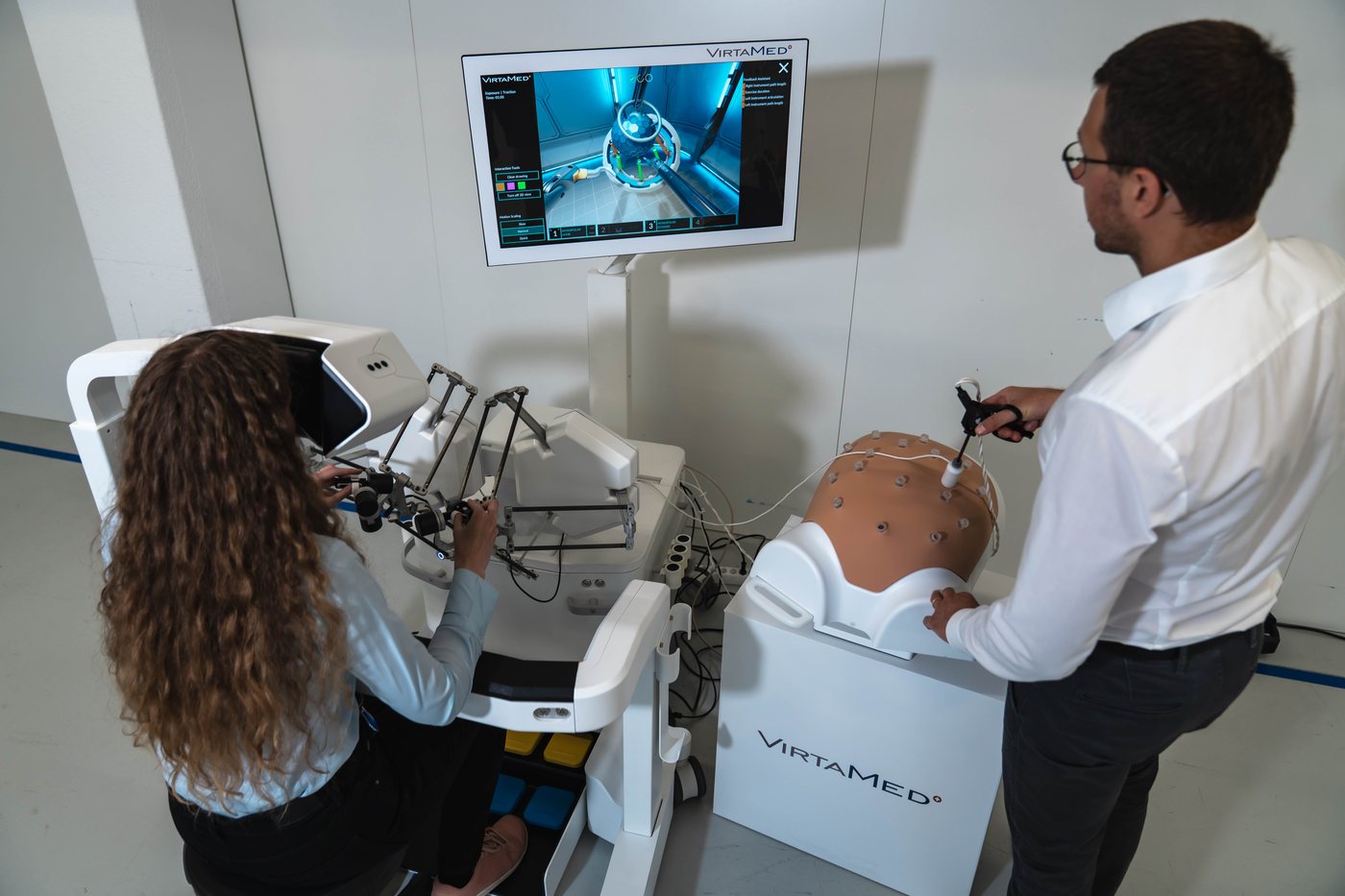
Even with a real robotic system the bedside assistant has nowhere to practise. RoboS is the first solution that trains both simultaneously — and that is not possible on the console itself.
8
CORE EXERCISES
17+
TROCAR PORTS
2
TRAINED SIMULTANEOUSLY
The module runs through the LaparoS™ haptic abdomen connected to RoboS. Half of the exercises exist in two variants — with and without explicit communication — to measure what speaking aloud adds.
MODULE “BASIC SKILLS” · 22 EXERCISES
01
Small and large corrections to view and position “without thinking”. The most economical sequence. Four exercises.
02
Full functionality of the instrument wrist, including working behind an obstacle. Five exercises across three levels.
03
The robotic console transmits no sense of touch. Tissue is “read” by deformation: firm, medium, soft — using the eyes alone.
04
Orienting to a set position, grasping perpendicular and away from the tip, equal use of both hands. Five exercises.
05
Transfer from the second to the fourth arm without instrument collision, with correct tension and precise cutting.
06
Simultaneous and precise grasping and movement with both hands.
07
One hand sets the traction and optimises the operative field, the other cuts. Traction and pushback.
08
The 30-degree optic and camera rotation — to look round the edge.
09
Switching between monopolar and bipolar energy with left and right pedals, with the instrument always in the visual field.
Procedural module
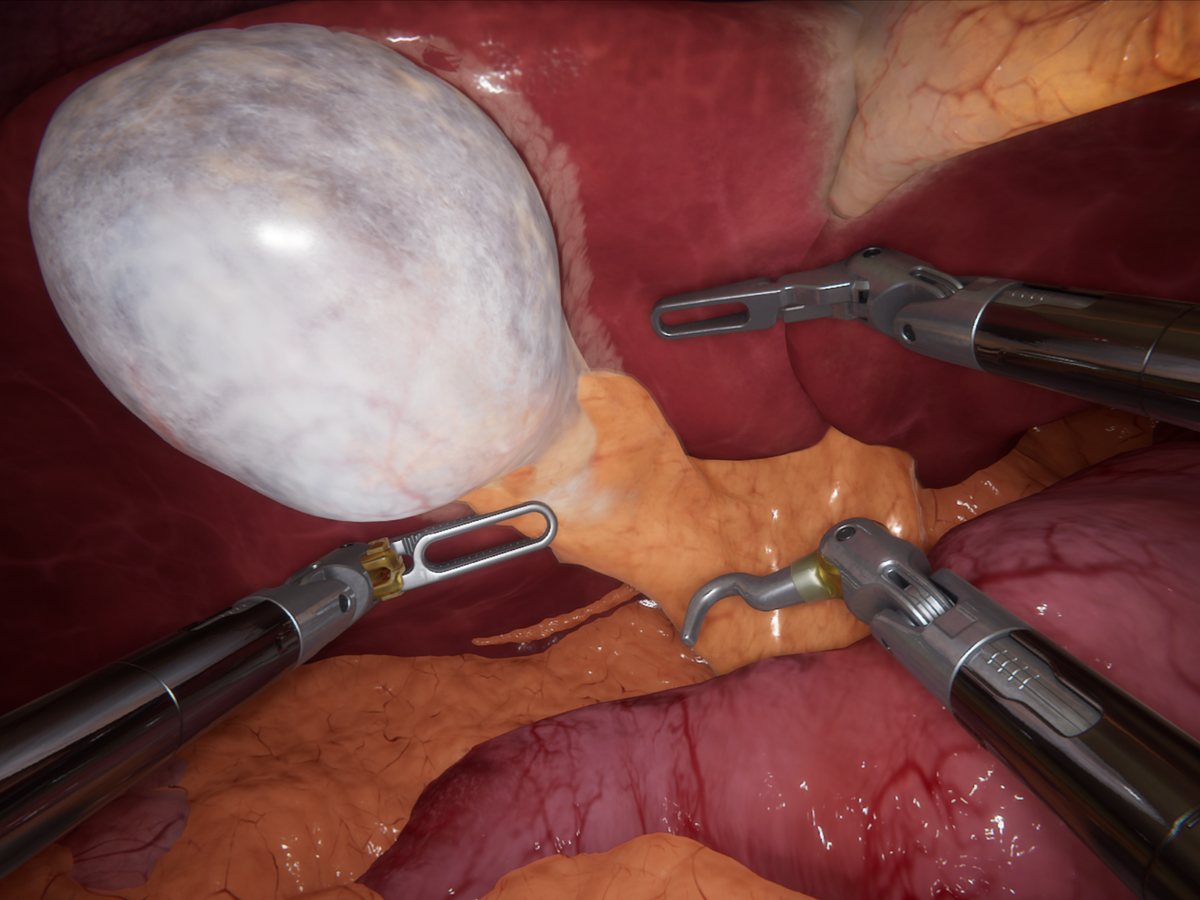
Not one textbook case, but three scenarios: uncomplicated, with acute cholecystitis and with a high-BMI patient. Each of them solo and as a team, plus separate exercises on the key steps.
Four arguments
01
The console is busy
Robotic systems operate throughout the working day. Without a second console outside the theatre, training simply cannot happen.
02
The hardware matches
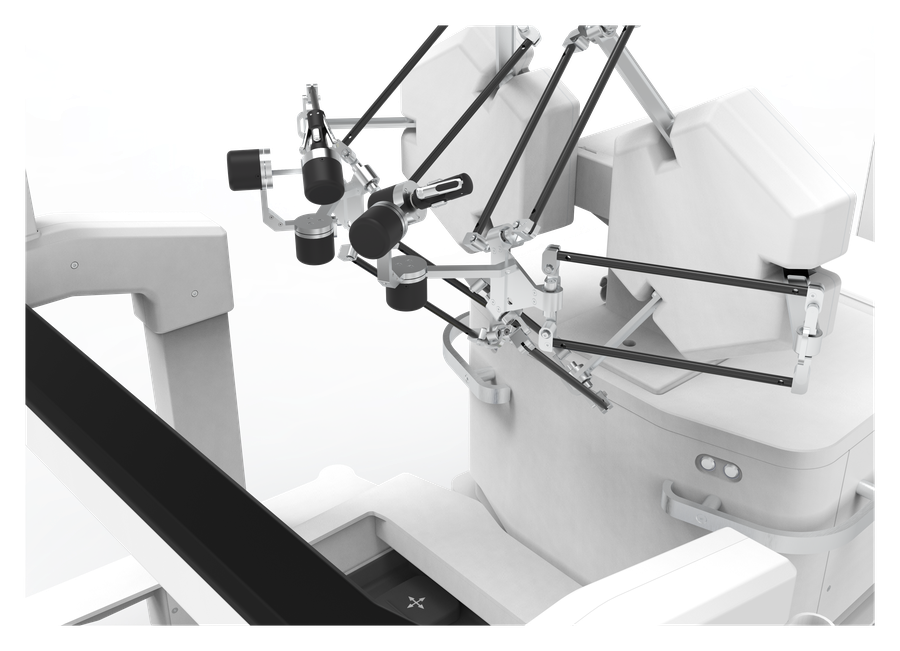
Hand grips, pedals, workspace, immersive display and seat — the interfaces that matter are reproduced.
03
Metrics guide
Assessment is not assessment for its own sake: it rewards safe behaviour and names unsafe behaviour explicitly.
04
The pathway is independent
The curriculum runs without depending on the theatre's free schedule — and is assembled by the clinic itself.
The platform is shared across the VirtaMed portfolio. The same device accepts modules for laparoscopy, gynaecology, urology and arthroscopy — changeover takes under ten minutes.
"For the first time, universities and hospitals will have a simulation system that allows them to make use of the precious time in robotic operating theatres. Before the surgeon and the hospital, the first to benefit is the patient."
JEAN-PIERRE HENRI · CHAIRMAN AND CO-FOUNDER, STAN INSTITUTE
EXPERT PANEL IN ROBOTIC SURGERY
01
Federico Gheza, MD, PhD
Artificial intelligence in medicine; expert in surgical training.
CONTENT
AND METRICS
02
Federico Serrot, MD
Medical director, bariatric and metabolic surgery, Cleveland Clinic, Florida.
CLINICAL
SCENARIOS
03
Roger Smith, PhD
Distinguished researcher in robotic surgery and simulation; a decade of teaching at AdventHealth Nicholson Center.
PLATFORM
ASSESSMENT
04
Jean-Pierre Henry
Chairman and co-founder, STAN Institute.
TRAINING
PROGRAMME
Training management
Courses are assembled remotely, each resident's progress is tracked, and device utilisation is visible from the desk or tablet. Trainees compare their own results over time.
FOR THE CLINIC
Who trained,
for how long and with what result.
The data remains with you. We help the curriculum be structured so that this data means something — Academy.
Independent assessment
A robotic programme requires more than a device. Before the proposal we clarify whether RoboS® is the right step for your hospital at all — including when the answer is “not yet”.
CHOLECYSTECTOMY — SCREEN RECORDING FROM THE SIMULATOR
Clipping and cutting of the cystic duct and artery during robotic cholecystectomy on VirtaMed RoboS
With your surgeon at the console and your bedside assistant — in the same session.
SMF · MATERIALS
Enter your e-mail and confirm with one click — the SMF overview of surgical simulation (PDF) arrives automatically. Free, no spam.