

"We can train emergency situations and learn how to handle complications — vascular injury or bowel transection — without it having cost a real case."
DR FELIX NEIS · HEAD, GYNAECOLOGY CLINIC, UNIVERSITY HOSPITAL TÜBINGEN
Home / Simulators / LaparoS
VirtaMed · Laparoscopy
The complication as a training level in its own right. And the only place where the non-dominant hand can be practised without it costing anything.

The training content, in full
The numbers are counted from VirtaMed's module descriptions. Total 94 exercises and cases — and for general surgery and gynaecology each case exists in four variants: guided and unguided, with normal organ arrangement and with situs inversus.
Basic skills
15
Bimanual coordination, peg transfer,
loop, needle driving, intracorporeal knot
AVAILABLE
General surgery
20
Scenarios from cholecystectomy, appendectomy
and ventral hernia — with adverse events
AVAILABLE
Colorectal surgery
10
Scenarios drawn from right
hemicolectomy
AVAILABLE
Suturing
12
Needle driving; half-hitch,
square and surgeon's knot
AVAILABLE
Advanced suturing
19
Ventral hernia and vaginal cuff closure;
real-time performance metrics
AVAILABLE
Gynaecological laparoscopy
18
Fertility surgery and gynaecological
procedures
AVAILABLE
SEPARATE LEVEL
The adverse
event
IS NOT A CASE —
A STEP IN THE PATHWAY
In most simulators the complication is simply another case. Here it is its own level in the learning pathway: basic skills first, then discrete tasks, then variants — and only at the end what to do when something goes wrong. The resident reaches that point once they already master the normal course. The modular approach is not a stylistic choice: it is proven to shorten the learning curve and reduce operative risk.2
2 Stolzenburg JU et al. Modular surgical training for endoscopic extraperitoneal radical prostatectomy. BJU Int. 2005 Nov; 96 (7): 1022–1027.
4
LEVELS IN GENERAL SURGERY
5
FLS SKILLS
What the textbook does not show
The hepatocystic triangle is drawn one way in the atlas and looks another way in the abdomen. LaparoS™ trains four documented variants — not one textbook case.
I
Short ductus cysticus
Short distance to the common bile duct — the most common cause of injury.
II
Ductus cysticus from the right hepatic duct
The duct does not come from where it is expected.
III
Arteria cystica from the right hepatic artery
The vessel crosses the field by an atypical route.
IV
Two cystic arteries
Clipping one does not stop the bleeding.
ONE CLIP IS NOT ENOUGH
The same principle applies to the appendix and the cystic pedicle. Each of the cases also exists in its mirror image — with situs inversus totalis.

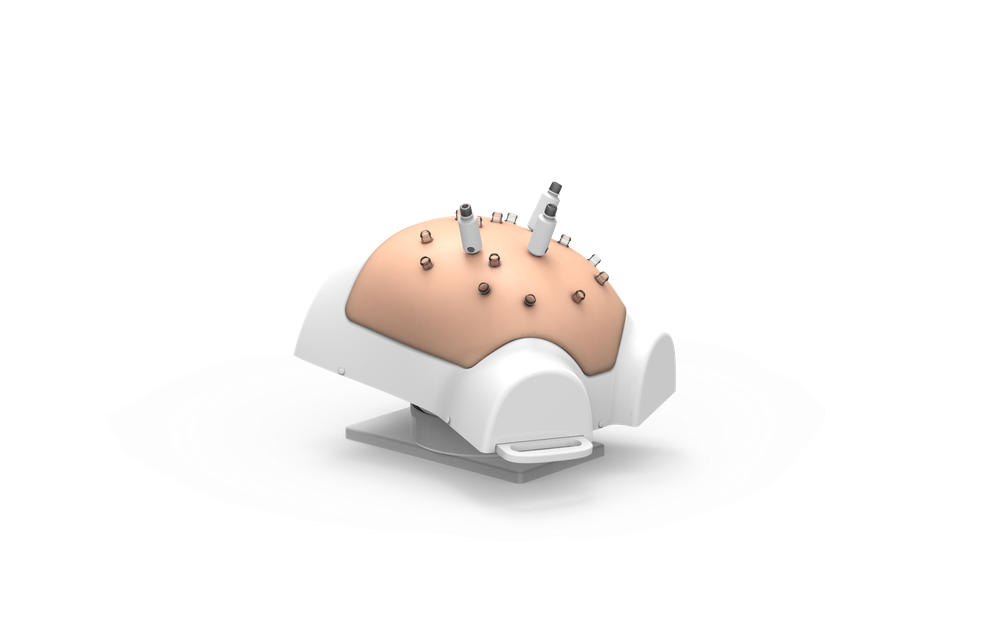
Before the first incision
Most simulators begin once the camera is already inside. Here, what comes before is also trained: patient positioning, the choice of trocar points, the triangulation of instruments.
1 Agostini J, Goasguen N, Mosnier H. Patient positioning in laparoscopic surgery: tricks and tips. Journal of Visceral Surgery 147 (4), 2010: 287–291.
The topic that is rarely discussed
Patient positioning, techniques and instruments are designed for right-handed surgeons. In cholecystectomy this is most evident. A survey of left-handed surgeons establishes what this means in practice.
~50%
have experienced anxiety
of the left-handed surgeons surveyed — because of their left-handedness during their residency.
1 : 4
had doubts at all
Every fourth left-handed surgeon experienced anxiety about whether to enter a surgical specialty.
< 1 : 10 000
situs inversus
Rare in the clinic — but as a simulator case it becomes a teaching tool.
"Operating on patients with situs inversus lets right-handed surgeons feel the lack of comfort and ergonomics their left-handed colleagues experience so often."
TCHANTCHALEISHVILI & MYERS · J SURG EDUC 2010;67(4):233–6
Reversing the anatomy forces the surgeon to relearn their visuomotor skills. For the left-hander this is the rare opportunity to work with their dominant hand; for the right-hander — a lesson in empathy.
The figures and the quotation come from the VirtaMed document Mastering Psychomotor Surgical Skills with Non-Dominant Hand Training (2022) and from the sources cited therein: Adusumilli et al., Curr Surg 2004;61(6):587–91; Al Jumaily & Hoche, J Laparoendosc Adv Surg Tech 2001;11(4):229–31.
Learning pathway
The pathway in general and colorectal surgery passes through four levels. In gynaecological laparoscopy — through three; variants are not present there.
01
Basic skills
Psychomotor foundation based on FLS
COMMON TO ALL
02
Discrete tasks
General, colorectal and gynaecological laparoscopy
BY SPECIALTY
03
Variants
General and colorectal surgery
TWO ONLY
04
Adverse events
Bleeding, vascular or bowel injury — management without a real patient
LAST
FOUR CLINICS
"We can train emergency situations and learn how to handle complications — vascular injury or bowel transection — without it having cost a real case."
DR FELIX NEIS · HEAD, GYNAECOLOGY CLINIC, UNIVERSITY HOSPITAL TÜBINGEN
"The entire procedure preparation is simulated, including the positioning of trocars."
PROF. DIETER HAHNLOSER · HEAD, CHUV LAUSANNE
"Reproduces exactly what we do with a real patient — and allows a complication to be added, for example bleeding."
DR IVAN PUENTE · DIRECTOR, GENERAL SURGERY PROGRAMME, BROWARD HEALTH
"Unmatched level of realism — with the greatest potential among the platforms compared."
PROF. AHMET AYAV · HEAD OF GENERAL SURGERY, UNIVERSITY HOSPITAL NANCY
Independent assessment
Whether you need a standalone LaparoS or the module on an existing device — that is a question of case volume, not preference.
LAPAROSCOPY — SCREEN RECORDING FROM THE SIMULATOR
VirtaMed LaparoS — shape matching skill (Essential Skills 2.0)
With the mobile unit, at a time convenient for you — and with the left-handers in your team.
SMF · MATERIALS
Enter your e-mail and confirm with one click — the SMF overview of surgical simulation (PDF) arrives automatically. Free, no spam.